Economia alla Bubka

The author & the award
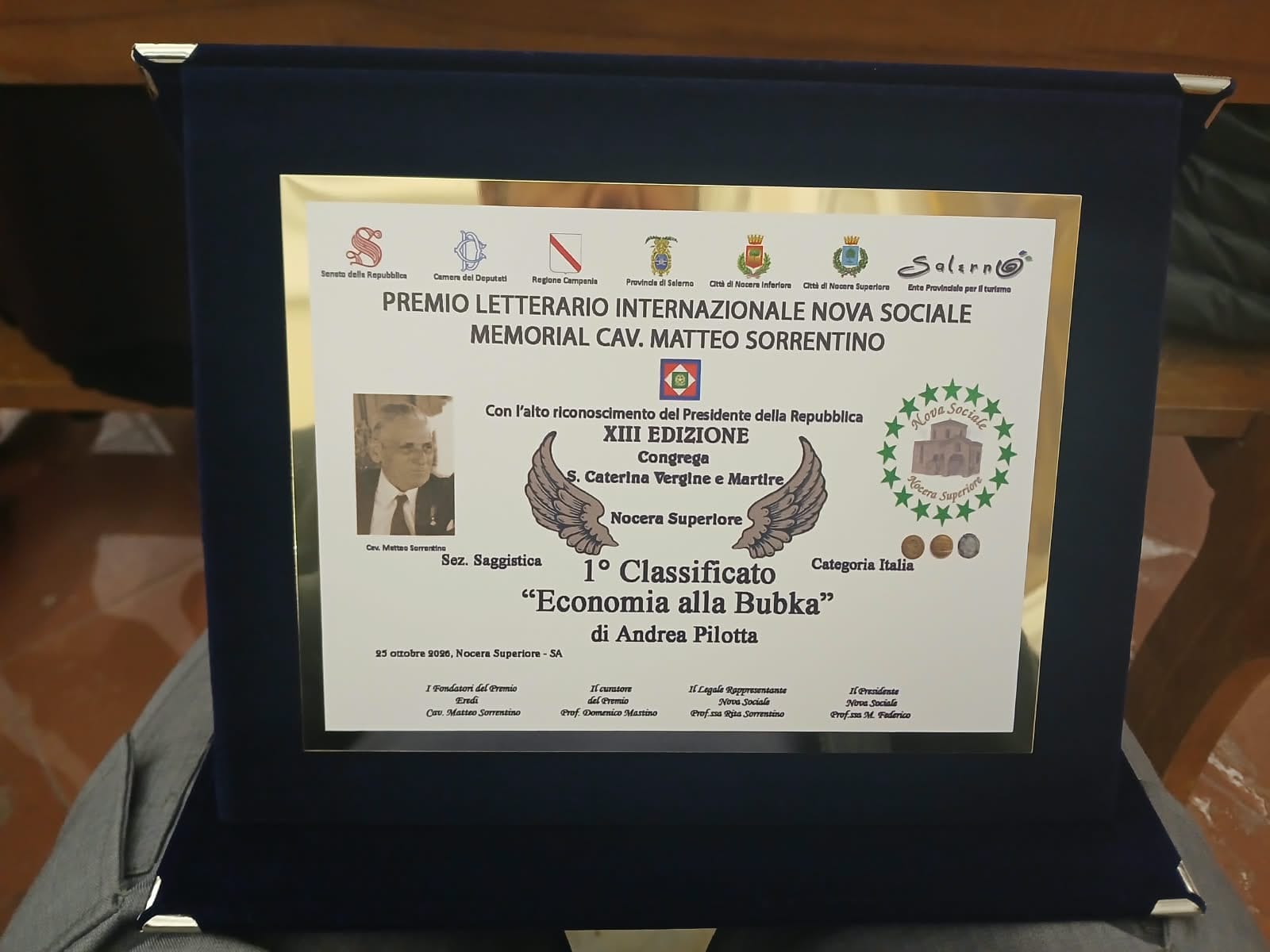
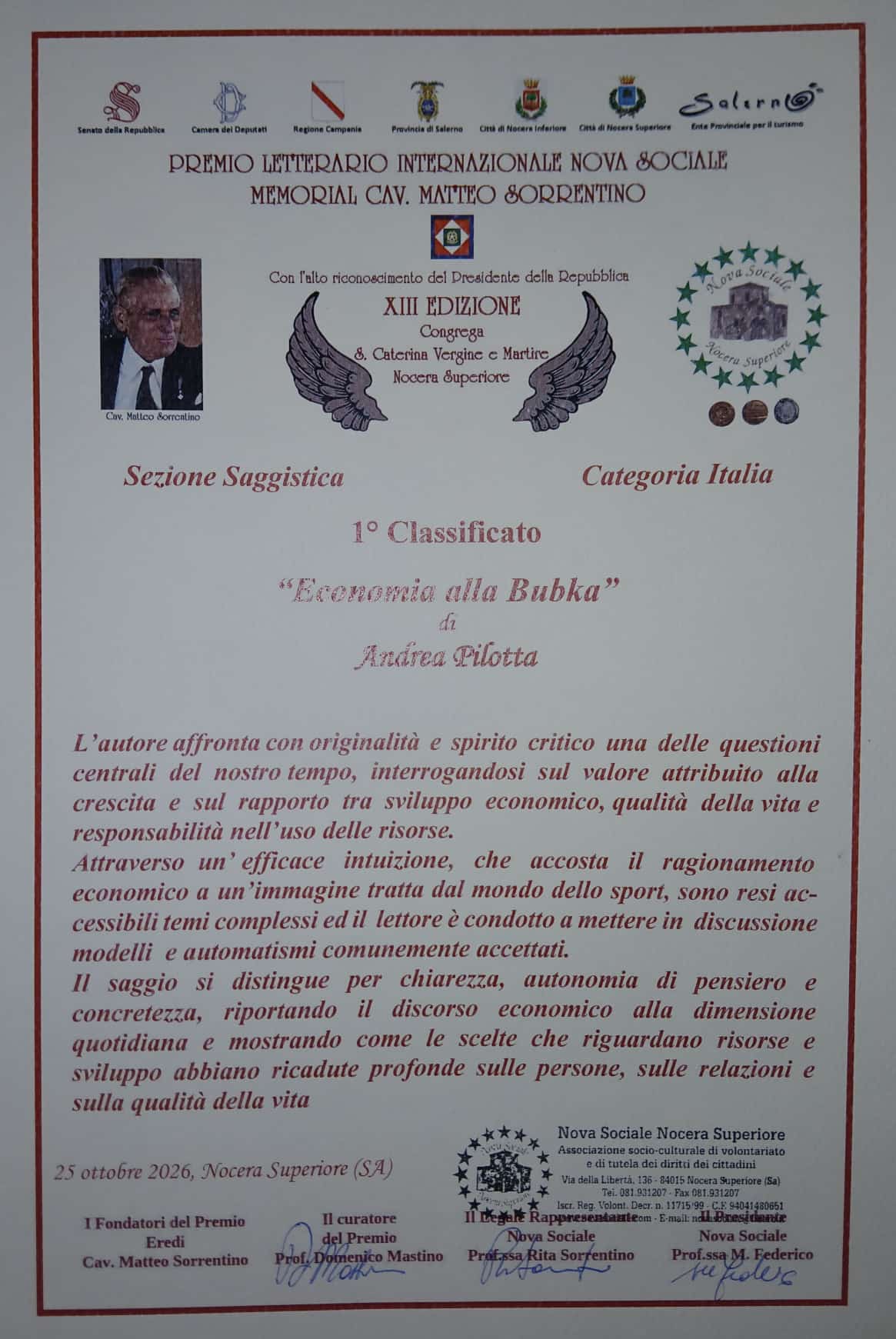
Andrea Pilotta is an Italian writer, and a friend of mine since the last century. He is one of the most fascinating souls and minds I have ever met, and he recently read to me one of his latest essays, Economia alla Bubka (Bubka‑Style Economics). I absolutely loved it — and it went on to take first place in the Saggistica (essay) category, Italy, at the XIII edition of the Premio Letterario Internazionale Nova Sociale (25 October 2026).
Andrea is also the author of the deeply moving book La rivoluzione d'amore (The Love Revolution), published in 2017. Subtitled "The Story of Papo Superhero, the Boy Braver Than Fear," it is a poignant, autobiographical work born out of personal tragedy.
Below is the translation of Andrea's winning essay, in which the record chase of the pole vaulter Sergey Bubka, one centimetre at a time, becomes a mirror of the growth economy we live in.
Bubka‑Style Economics
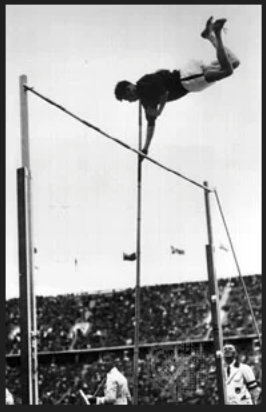
He went down in history as a great athlete. But look truly at the arc of his sporting career and there is no way around it: he ranks among the greatest economists and entrepreneurs of the self in the twentieth century. An early model of what we now call productive economic activity. A forerunner. Sergey Bubka. Barely twenty, in 1983, he wins a meet in Helsinki with a clearance of five meters and seventy. The world understands: the king of the pole is about to arrive. On July 13, 1985, he becomes the first man to clear six meters — a height long considered beyond reach.
He kept improving, time after time, a little at a stretch. In four years, from 1984 to 1988, he extended the world record by twenty-one centimeters. Over the course of his entire career, he set thirty-five new world records.
The stroke of genius was in rationing himself, jump by jump. The Soviet Union — which Bubka represented then, born in Luhansk, in Ukraine, and destined later to compete for his own country — during the height of the Cold War paid substantial cash prizes for every record broken.
So Sergey Bubka jumped one centimeter at a time.
Not because he couldn't jump higher. Because each centimeter was a new record, a milestone to collect. His body could do it, his technique could too. The bar, after all, was not a limit — it was a tool. You simply raised it a little. Just enough to keep winning.
Bubka was not searching for the impossible jump. He was searching for the repeatable one.
And in this he was less an athlete than an economic model.
The idea of progress we practice today looks a great deal like his: not going truly far, but always a little further than yesterday. A centimeter at a time — as long as it is forward. As long as you can say you have grown. In this game, stopping is not an option. Stopping means stepping off the field.
The economy we inhabit grows this way: by habit. It produces, consumes, expands — not because it must, but because it has to, in order to keep growing. Every year it must outperform the last; every quarter must surpass the one before. It does not matter toward what. It does not matter for whom. What matters is that the jump continues, that the bar never stands still.
The problem is not moral. It is structural.
A system that must grow endlessly, even when it already has everything, is not evil. It is blind.
It keeps moving even when no direction remains. Like an athlete who jumps not to go further, but to avoid stopping.
This is how we work more to afford things we have no time to use. How we save time only to fill it with activity that consumes it. How we streamline processes that produce nothing.
Growth becomes a reflex, not a choice.
But at some point the extra centimeter no longer improves the jump. It stiffens it. Makes it labored, mechanical. That is where intelligence should intervene. Not the kind that invents a new record, but the kind that recognizes a limit as a form of measure.
The true reversal is not to stop growing. It is to stop growing out of inertia.
It is to realize that not every improvement is progress, that not every increase is a gain. That there is a point beyond which climbing further serves no purpose — except to stay locked into the mechanism.
Shift your gaze, and the economy ceases to look like an abstract machine. It returns to what it has always been: the stewardship of the household. Not the world in some abstract sense, but the concrete home. Time, relationships, resources, balance — all things that do not grow without end and that, when forced, break.
A community does not thrive because it produces more. It thrives because it holds together.
A life's work is not measured by what it yields, but by how much living it leaves behind.
A system is healthy when it can stop without collapsing.
Perhaps the wisest jump is not the one that clears the highest bar.
Perhaps it is the one that recognizes when the bar is already high enough.
Because keep jumping, just to prove you can, and it is no longer progress.
It is compulsion.
A few notes on translation choices:
- "Accanimento" (the final word) carries in Italian a strong sense of obstinate, purposeless persistence — a clinical or moral overreach, grinding on long past any point of utility. Compulsion captures that in English without losing the essay's quiet finality.
- "Centellinarsi" (to dose oneself, to ration oneself out) became rationing himself, jump by jump, which preserves both the economic register and the physical image.
- "Regge" (holds, sustains, stands) became holds together, which reads more naturally in English while keeping the structural metaphor intact.
Prizes